
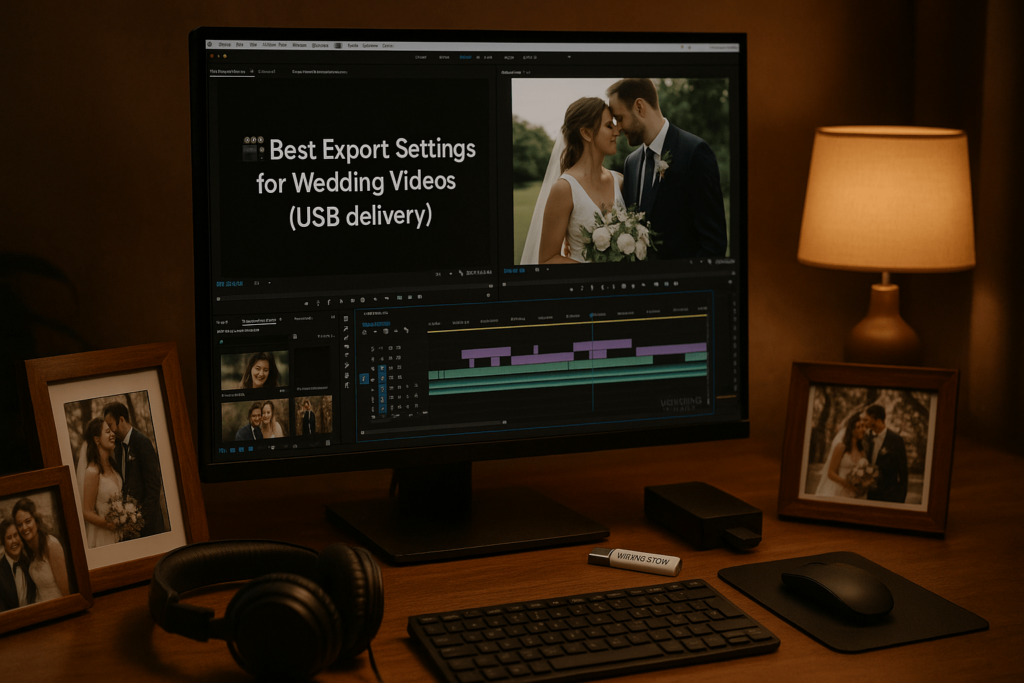
πŸŽ₯ Best Export Settings for Wedding Videos (USB delivery)

βœ… Format:

H.264 (.mp4) β€” Most universally supported across TVs and USB media players.

βœ… Resolution:

  • 4K: 3840 x 2160 (if shot in 4K and client expects UHD quality)
  • Full HD: 1920 x 1080 (standard and widely compatible)

⚠️ Check if the TV/player supports 4K. If unsure, stick to 1080p.

βœ… Frame Rate:

Match your timeline (typically 25 fps or 30 fps, depending on country)

βœ… Bitrate (VBR 1-pass or 2-pass):

  • 4K: 35–60 Mbps
  • 1080p: 10–20 Mbps

Use VBR 2-pass if you want better quality and smaller file size.

βœ… Audio:

  • AAC, 48 kHz, 320 kbps

βœ… File Size Consideration:

  • If the pendrive is FAT32 formatted, the file must be under 4GB.
    • You may need to split the video into multiple parts or reformat the USB.
  • For larger single files, reformat the pendrive to exFAT (supported by most modern TVs).


πŸ’‘ Recommended Export Preset in Premiere Pro or Final Cut:

  • Format: H.264
  • Preset: Match Source – High Bitrate
  • Profile: High
  • Level: 4.2 (for 1080p), 5.1 (for 4K)


βœ… Final Tip:

  • Name the file clearly, e.g. Claire_&_Mark_Wedding_2025.mp4
  • Test the exported video on a TV via USB before giving it to the client.


πŸŽ₯ Ideal Bitrate for 4K Wedding Videos (2025)

βœ… Target Range (for H.264 .mp4 export):

  • Standard 4K (3840 x 2160):
    • Bitrate: 40 to 65 Mbps (VBR 1-pass or 2-pass)
    • Sweet spot for weddings: 50 Mbps average
    • Max bitrate: Up to 75 Mbps if you want premium quality and file size isn’t a concern

πŸ“Œ For a 60–90 min wedding film, this results in a file size of around 20–30 GB.

βœ… If using H.265 (HEVC):

  • You can get similar quality at 50% lower bitrate, e.g. 25–35 Mbps.

🎯 Use H.265 only if you know the client’s TV supports it β€” not all older TVs or USB players do.


🧠 Bitrate Recommendations by File Type

CodecResolutionBitrateFile Size per HourCompatibility
H.2644K50 Mbps~22 GBExcellent
H.2654K25–30 Mbps~12–14 GBGood (new TVs only)
ProRes LT4K~85–100 Mbps~40–45 GBMac & pro use only

βš™οΈ Other Settings to Consider:

  • Audio: AAC, 48 kHz, 320 kbps
  • Profile: High
  • Level: 5.1 (for 4K)


πŸ’‘ Final Tips:

  • Format USB as exFAT (to avoid FAT32’s 4GB file limit).
  • Stick with H.264 50 Mbps if unsure about compatibility.
  • Test on a real TV before final delivery.

The best USB pendrive format to ensure full compatibility with both Windows and macOS (including modern Smart TVs) is:

βœ… exFAT (Extended File Allocation Table)

πŸ”Ή Why exFAT?

  • Works on both Windows and Mac without extra drivers.
  • Supports files larger than 4GB (unlike FAT32).
  • Compatible with most modern Smart TVs, especially post-2018.
  • More stable for video playback, especially high-bitrate 4K.


πŸ› οΈ How to Format USB to exFAT

πŸ”Έ On Windows:

  1. Plug in your USB stick.
  2. Open File Explorer > Right-click on the USB drive.
  3. Choose Format.
  4. Under File System, select exFAT.
  5. Keep Allocation Unit Size as Default.
  6. Click Start.

πŸ”Έ On macOS:

  1. Open Disk Utility.
  2. Select the USB stick from the left sidebar.
  3. Click Erase.
  4. Choose:
    • Format: exFAT
    • Scheme: GUID Partition Map (for better cross-compatibility)
  5. Click Erase.


⚠️ Avoid These Formats:

  • FAT32: Too old. Doesn’t support files over 4GB.
  • NTFS: Windows-only. Mac can only read, not write.
  • APFS/Mac OS Extended: macOS-only. Windows can’t read these natively.

The Cost of Keeping Up: The Price of Evolving Technology in Creative Professions

Today’s fast world is matched only by the lightning-fast pace at which technology is developing. As creative professionals such as graphic designers, photographers, videographers, and digital marketers, we are always expanding our knowledge base, refining our techniques, and improving our equipment. The price of maintaining a state of technological and cultural relevance is high, though.


Professionals in these sectors devote a great deal of time and money to providing clients with the best possible service and staying ahead of the competition. Due to the ever-changing technological landscape, we must regularly update our hardware, software, and other resources to ensure optimal performance.


Mastering cutting-edge methods and tools sometimes involves a steep learning curve. Photographers need to use modern cameras and editing software; videographers must master new filming and editing methods; and digital marketers must keep up with ever-changing algorithms and advertising platforms.


Keeping up with technology also calls for a hefty financial commitment. The price tag includes everything from new technology and software to workshops, conferences, licencing, subscriptions, and specialised training. As professionals, it is our responsibility to make these payments and maintain a financially stable company.


Consider not only the final product or service when thinking about the hourly rates paid by specialists in various industries. A lot of time, energy, and money are put in behind the scenes to ensure a high-quality result. Charges are reflective of the time, money, and effort required to maintain the highest levels of expertise and knowledge in one’s field.


Clients and customers must understand the value that these experts bring to the table. A better understanding of the price structure and the development of a mutually beneficial relationship between service providers and clients can be fostered by recognising the substantial investment required to stay current and achieve great results.

The Power of Videography in Today’s Age: Elevating Marketing through Dynamic Visual Storytelling

Videography has emerged as a powerful tool in today’s digital age, transforming the way businesses connect with their audiences and convey messages. Here are various aspects of videography and how they contribute to marketing success:

  1. Promotional Videos: Promotional videos are an effective way to showcase products, services, or events in a visually compelling manner. They allow businesses to engage their target audience, highlight key features, evoke emotions, and generate interest and excitement, ultimately driving conversions and sales.
  2. Wedding Videos: Wedding videography captures precious moments and emotions, creating lasting memories for couples and their loved ones. It enables couples to relive their special day and share their joy with others. Wedding videographers have the power to tell unique love stories through visually stunning and emotionally resonant films.
  3. Social Media Reels: Platforms like Facebook and Instagram Reels provide a space for short-form, visually captivating videos. Marketers leverage these formats to engage and entertain audiences in a concise and engaging way. By crafting compelling reels that align with their brand, businesses can increase visibility, attract new followers, and enhance brand awareness.
  4. YouTube Shorts: YouTube Shorts, with its vertical video format, offers an opportunity for businesses to create snackable and engaging content. It allows for quick storytelling, educational content, or behind-the-scenes glimpses. Utilising YouTube shorts can help brands expand their reach, increase subscribers, and drive traffic to their channels or websites.
  5. Drone Footage: Drone videography has revolutionised the way we capture visuals from unique perspectives. It enables businesses to showcase landscapes, properties, events, or products from breathtaking aerial angles. Drone footage adds a wow factor to marketing materials, creating a memorable and immersive experience for viewers.
  6. Visual Storytelling: Videography enables businesses to tell compelling stories visually. Through captivating narratives, emotional connections, and engaging visuals, brands can create a powerful impact on their audience. Visual storytelling elicits emotions, builds brand loyalty, and enhances customer engagement.
  7. Enhanced Engagement: Videos have a higher engagement rate compared to other forms of content. They capture attention, convey information more effectively, and encourage social sharing. Incorporating videos in marketing campaigns boosts engagement, increases reach, and fosters deeper connections with the target audience.
  8. Brand Personality and Authenticity: Videography allows businesses to showcase their brand’s personality, values, and culture. It humanises the brand, making it relatable and authentic to the audience. By visually expressing the brand’s unique identity, videography creates a strong and memorable impression on viewers.
  9. Mobile-Friendly Consumption: With the rise of mobile usage, videos have become easily accessible and consumable on smartphones. Mobile-friendly videography caters to on-the-go viewers, expanding the reach and potential audience for businesses.

Videography has become an essential tool in modern marketing strategies, enabling businesses to captivate and engage audiences, build brand identity, and convey messages in an impactful and memorable way. By leveraging the power of videography, businesses can effectively connect with their target market and achieve their marketing objectives in today’s digital landscape.